
What Is a Mica Board Cutting Machine?
How Modern Factories Process Mica Boards with Higher Precision and Stability
For heating element manufacturers, the biggest challenge in mica processing is rarely just “cutting speed.” The real concern is whether the machine can maintain dimensional consistency, avoid edge cracking, reduce scrap rates, and support stable long-term production. A modern mica board cutting machine is designed to solve these exact problems by combining automated feeding, CNC-controlled sizing, and precision cutting technology for electrical insulation processing.
In today’s appliance and industrial heater market, manufacturers are under pressure to improve assembly consistency while lowering labor dependency. That is why automated mica cutting solutions are becoming increasingly common in factories producing mica heaters, band heaters, insulation panels, and high-temperature electrical components.
What Is a Mica Board Cutting Machine?
A mica board cutting machine is specialized industrial equipment used for trimming, cutting, slitting, and shaping rigid insulation materials such as mica boards, fiberboards, epoxy boards, and composite insulation sheets. These machines are widely used in heating element manufacturing and electrical insulation processing where precise dimensions and clean edge quality are critical.
Unlike manual cutting setups or standard workshop cutters, industrial mica machining equipment is engineered specifically for brittle high-temperature insulation materials. The machine structure, feeding system, spindle stability, and CNC control logic are all designed to reduce dimensional deviation and improve production repeatability.
In practical manufacturing environments, a precision mica processing system normally performs several important tasks simultaneously:
- Automatic feeding and positioning
- Four-edge trimming and sheet sizing
- Multi-specification cutting
- Continuous slitting operations
- Batch production with stable tolerances
Factories supplying export appliances and industrial heaters increasingly rely on automated mica cutting solutions because dimensional consistency directly affects heater assembly efficiency and electrical insulation reliability.
Why Has Precision Become So Important in Mica Sheet Processing?
Several years ago, many factories still relied on semi-manual cutting tables or operator-dependent trimming methods. Those systems were acceptable for low-volume production, but modern heater manufacturing standards have changed significantly.
Today, even small dimensional variation can create:
- Poor heater assembly alignment
- Insulation instability during thermal cycling
- Higher rejection rates
- Inconsistent resistance spacing
- Safety certification failures
Research related to insulation board manufacturing consistently shows that accurate trimming and stable edge quality improve both assembly consistency and operational reliability. This is particularly important for high-temperature mica applications used in heating elements and electrical insulation structures.
That is why precision mica processing equipment is no longer viewed simply as auxiliary machinery. In many factories, it has become a critical part of overall manufacturing quality control.
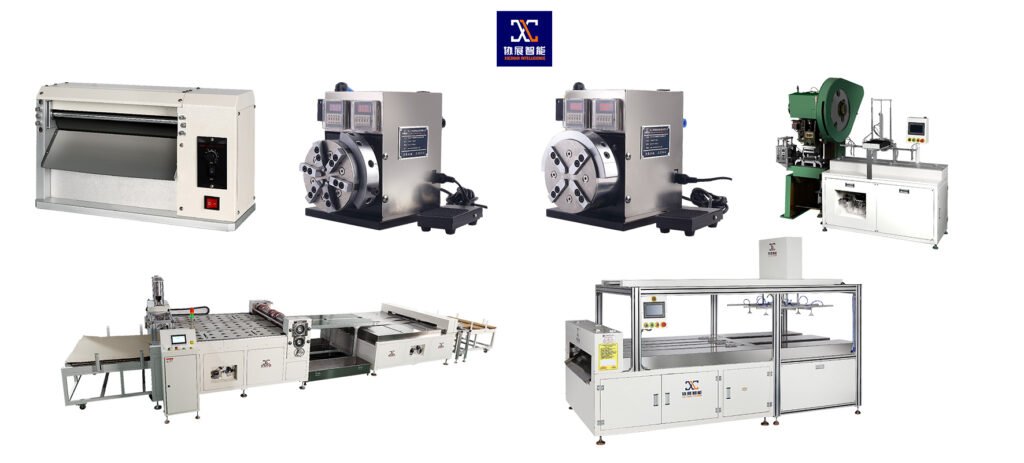
Common Types of Mica Sheet Processing Machines Used in Industry
Different production environments require different mica processing configurations. Some factories focus on large insulation panels, while others process thin mica sheets for compact heating components.
| Machine Type | Main Function | Typical Applications |
|---|---|---|
| Mica Board Cutting Machine | Board cutting and slitting | Heating elements and insulation panels |
| Four Edge Trimming Machine | Precise edge correction | High-accuracy heater production |
| Mica Punching Equipment | Hole punching and shaping | Component manufacturing |
| Mica Paper Forming Machine | Roll forming and shaping | Hair dryer mica structures |
You can explore more related equipment on our Mica Sheet & Mica Board Processing Machines page.
How Do Modern Automated Mica Cutting Solutions Work?
Modern mica sheet processing machines are designed around stability, repeatability, and production flexibility. Instead of relying heavily on manual positioning, the system integrates automated feeding, servo-driven cutting, and CNC size adjustment to maintain consistent cutting performance.
One good example is the XZ-XB1300 Fully Automatic Mica Board Four Edge Trimming and Cutting Machine developed by Guangdong Xiezhan. This equipment is designed specifically for edge trimming, slitting, and precision cutting of flat insulation materials.
The machine supports:
- Automatic sheet loading
- CNC-adjustable cutting dimensions
- Multi-specification cutting capability
- Servo spindle motor control
- ±0.2mm cutting accuracy
- 0–6mm insulation board thickness processing
In actual production, machines like the XZ-XB1300 are commonly used for mica boards, epoxy boards, fiberboards, and even certain metal sheet processing applications where dimensional consistency is critical.
Four-edge trimming is especially important in industrial mica machining because uneven edges often create assembly positioning issues later in the production process. Factories producing large heating elements usually pay close attention to this detail because poor trimming quality increases both scrap rates and manual correction work.
What Makes High-Precision Mica Processing Different from Basic Cutting?
A basic cutting machine may appear similar externally, but long-term production performance depends on several deeper engineering factors.
1. Feeding Stability
Positioning accuracy becomes increasingly important in repetitive production. Poor feeding alignment creates cumulative dimensional errors, especially in continuous slitting applications.
2. Servo Control Precision
Servo-driven spindle systems improve motion stability and reduce vibration during cutting operations. This directly affects edge cleanliness and tolerance consistency.
3. Structural Rigidity
A rigid frame structure helps maintain dimensional stability during continuous operation, especially when processing larger mica boards.
4. CNC Dimension Adjustment
Factories producing multiple heater specifications need flexible size control without constant manual adjustment. CNC setting systems reduce downtime and improve production efficiency.
The XZ-JB1212 Fully Automatic Mica Board Cutting Machine is a good example of this production approach. Compared with larger trimming systems, the XZ-JB1212 focuses more on stable, repeatable cutting and slitting for thinner insulation boards.
This model supports:
- Automatic feeding systems
- CNC size setting
- ±0.2mm cutting accuracy
- 0–3mm thin board processing
- Servo spindle motor control
- Stable multi-specification cutting
In many heating element factories, this type of mica sheet processing machine is preferred for compact insulation structures and medium-scale production where stable dimensional control matters more than maximum cutting force.
Why Are Automated Systems Replacing Manual Processing?
The shift toward automation is happening for practical manufacturing reasons rather than technology trends alone.
Manual processing creates several long-term problems:
- Operator-dependent accuracy variation
- Higher labor costs
- Lower repeatability between batches
- Higher material waste
- Difficulty scaling production
For export-oriented manufacturers, unstable electrical insulation processing often creates downstream assembly problems that become expensive to correct later.
Automated mica cutting solutions help factories maintain:
- Stable dimensional tolerances
- Cleaner cutting edges
- Consistent production speed
- Reduced scrap generation
- Better assembly consistency
What Should Buyers Evaluate Before Purchasing a Mica Board Cutting Machine?
Many buyers initially compare only machine price or maximum speed. In practice, experienced factories evaluate equipment from a much broader production perspective.
| Evaluation Point | Production Impact |
|---|---|
| Cutting Accuracy | Directly affects assembly precision |
| Automation Level | Influences labor efficiency and scalability |
| Material Compatibility | Supports different insulation boards |
| Control System Stability | Improves production consistency |
| Technical Support | Reduces production downtime |
In my experience working with international heater manufacturers, the factories achieving the best long-term results are usually not the ones buying the cheapest machine. They are the factories choosing equipment that matches their actual production structure, material type, and future automation plans.
You can review our manufacturing background and engineering capabilities on the About Us page.
You may also explore some real project cooperation cases through our Client Cooperation section.
Final Thoughts from a Production Perspective
A mica board cutting machine is no longer just a simple workshop tool. In modern heating element manufacturing, it plays an important role in insulation consistency, assembly quality, material utilization, and overall production stability.
As heater manufacturers continue moving toward automation and higher production consistency, precision mica processing equipment will become increasingly important for maintaining competitiveness in both domestic and export markets.
Machines such as the XZ-XB1300 and XZ-JB1212 demonstrate how automated mica cutting solutions are evolving beyond basic cutting functions into integrated manufacturing systems capable of supporting long-term industrial production.
If you are currently evaluating a mica sheet processing machine for heating element production or electrical insulation applications, you can contact our engineering team through the Contact Us page for technical recommendations and production discussions.