
How Mica Heaters Are Manufactured Step by Step
Understanding the Complete Manufacturing Process Behind Industrial Mica Heaters
When buyers evaluate a mica heater supplier, one question often determines whether the factory can consistently deliver quality products: how is the mica heater actually manufactured? The answer matters because heater performance is not created during final assembly. It begins much earlier with insulation preparation, mica forming accuracy, resistance wire placement, and process consistency. A well-designed mica heater processing machine system ensures every stage contributes to thermal stability, electrical safety, and long service life.
In my experience working with heating element manufacturers across multiple countries, production problems rarely originate from a single component. Most failures occur because small errors accumulate throughout the manufacturing process. Understanding how mica heaters are made helps buyers identify capable suppliers and avoid unnecessary quality risks.
Insight
Many factories focus on resistance wire specifications while overlooking mica preparation accuracy. In reality, dimensional variation in mica components often becomes the root cause of heater assembly inconsistency.
The Main Problem: Why Do Mica Heater Quality Levels Vary Between Factories?
Two heaters may look identical externally yet perform very differently in actual operation.
Common issues include:
- Uneven heating distribution
- Premature insulation failure
- Electrical leakage
- Shortened service life
- Assembly instability
- Inconsistent resistance values
Most of these problems originate from manufacturing process control rather than raw material selection alone.
A reliable mica heater production line requires coordinated operation between mica heater assembly tools, mica element forming machine systems, cutting equipment, and inspection procedures.
The Root Cause: Every Manufacturing Stage Influences Final Heater Performance
Mica heaters are not single-piece products. They are assemblies consisting of insulation materials, resistance wire, conductive terminals, supporting structures, and fastening components.
Each stage influences final performance.
| Production Stage | Main Objective | Risk Factor | Impact | Control Method |
|---|---|---|---|---|
| Mica Cutting | Dimensional Accuracy | Position Error | Assembly Variation | CNC Cutting |
| Mica Forming | Shape Consistency | Deformation | Poor Fit | Controlled Forming |
| Wire Placement | Heat Distribution | Spacing Error | Hot Spots | Guided Assembly |
| Final Assembly | Structural Integrity | Misalignment | Product Failure | Inspection |
Step 1: Preparing Mica Insulation Components
The process begins with mica sheet preparation.
Depending on heater design, manufacturers may use flat mica boards, mica paper laminates, or specially formed insulation structures.
For high-volume production, dimensional consistency becomes critical.
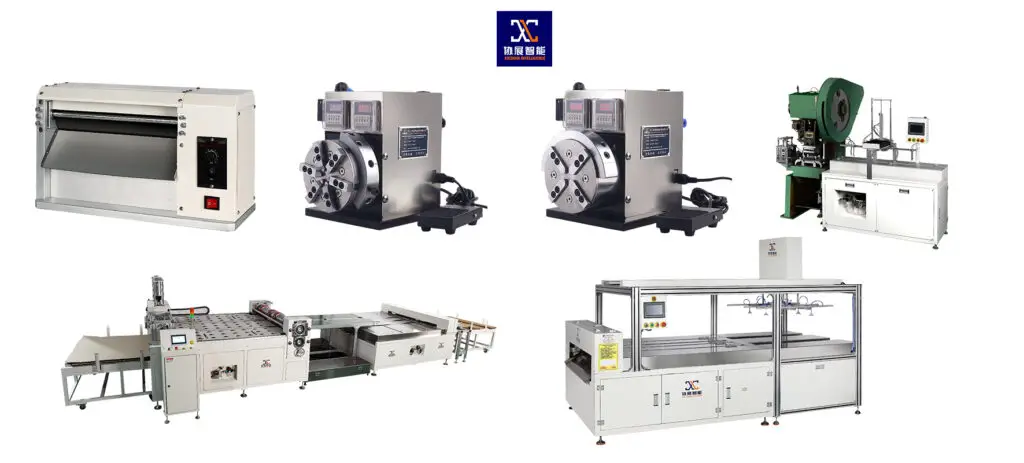
Factories commonly use CNC-based equipment such as the XZ-JB1212 Fully Automatic Mica Board Cutting Machine and XZ-XB1300 Fully Automatic Mica Board Four Edge Trimming and Cutting Machine to ensure stable cutting accuracy and repeatable dimensions.
Both machines support automatic feeding, CNC size adjustment, and high-precision processing of insulation materials used in heater manufacturing.
Advice
If your supplier still relies heavily on manual mica cutting, request dimensional consistency reports. Variations during this stage often create assembly problems later.
Step 2: Forming Mica into Functional Heater Structures
Once raw mica components are cut, many products require forming operations.
Hair dryers, fan heaters, and compact heating assemblies frequently utilize rolled or curved mica structures.
This is where a dedicated mica element forming machine becomes essential.
For example, the XZ-J730D Mica Paper Molding Machine is designed specifically for mica roll processing applications. Supporting mica thicknesses from 0.4–1mm and widths up to 300mm, it allows manufacturers to create stable cylindrical insulation structures used in many appliance heating systems.
Step 3: Stamping and Component Preparation
Many mica heater designs require mounting holes, slots, positioning structures, and assembly features.
These operations are typically completed through automated stamping processes.
The XZ-SL300 Mica Sheet Automatic Stamping and Feeding Machine is designed to work alongside stamping presses, automatically feeding mica sheets and improving production efficiency while reducing labor requirements.
Its automatic loading system supports board widths from 30–300mm and helps maintain consistent material positioning during repetitive production.
Step 4: Resistance Wire Installation and Heater Core Processing
This stage is where thermal performance begins to take shape.
The resistance wire must be positioned according to engineered spacing requirements.
Improper spacing can create:
- Localized overheating
- Uneven temperature distribution
- Reduced heater lifespan
- Insulation stress concentration
Accurate mica heater core processing ensures the insulation structure and resistance wire work together as an integrated thermal system.
Advice
Ask suppliers whether resistance wire placement is controlled by fixtures, templates, or automated guidance systems. This directly affects thermal consistency.
Step 5: Final Assembly and Structural Integration
After the insulation and heating components are prepared, final assembly begins.
This stage combines:
- Mica insulation structures
- Resistance wire systems
- Terminal connections
- Metal sheath structures
- Fastening components
The effectiveness of mica heater assembly tools largely determines production consistency during this phase.
Factories producing mica band heater manufacturing products often invest heavily in assembly fixtures because assembly accuracy directly impacts product repeatability.
| Quality Check | Purpose | Typical Method | Risk Prevented | Production Benefit |
|---|---|---|---|---|
| Dimension Check | Fit Verification | Measurement | Assembly Error | Consistency |
| Resistance Test | Performance Control | Electrical Test | Heating Variation | Reliability |
| Insulation Test | Safety Validation | Dielectric Test | Electrical Leakage | Compliance |
| Visual Inspection | Assembly Quality | Operator Review | Defects | Yield Improvement |
The Solution: Building a Stable Mica Heater Manufacturing System
The highest-performing heater factories do not rely on one exceptional machine. They build a coordinated production system.
This typically includes:
- Precision mica cutting
- Controlled mica forming
- Automated feeding
- Structured assembly
- Repeatable quality verification
This is why many global manufacturers invest in complete processing workflows rather than isolated equipment purchases.
Production Reality
Factories that consistently achieve lower rejection rates usually have tighter process control between cutting, forming, and assembly stages rather than relying solely on final inspection.
For buyers evaluating manufacturing capability, it is often useful to review the supplier’s complete processing infrastructure rather than focusing only on finished samples.
You can explore related production equipment on our Mica Sheet & Mica Board Processing Machines page.
To understand how we support international manufacturers, visit our Client Cooperation section and learn more about our About Us page.
Advice
When comparing suppliers, request information about their complete mica heater processing workflow. Strong process control is often a better indicator of long-term product quality than price alone.
Final Thoughts
Mica heater manufacturing is a multi-stage engineering process that combines insulation technology, forming accuracy, resistance wire management, and assembly consistency.
Every stage contributes to the final performance customers experience in the field.
The manufacturers that consistently produce reliable heaters are usually those that understand how each process step affects the next. From mica cutting and forming to heater core processing and final assembly, quality is built progressively rather than inspected into the product at the end.
If you are planning a new mica heater production line or evaluating automation upgrades, our engineering team can help analyze your manufacturing requirements. Contact us through our Contact Us page for technical consultation.
Contact Our Team
Similar Posts
Top 10 CNC Wire Winding Machine Manufacturers in China
ByXiezhanManufacturer’s Sourcing Guide · 2026 CNC Wire Winding Machine Manufacturers in China:A Buyer’s Guide from Inside the Industry This guide is written by XieZhan Intelligent Technology — a Zhongshan-based CNC winding machine manufacturer. We explain what to look for, what to avoid, and how to identify the right supplier for your application. Other manufacturers mentioned…
Why Heating Element Design Should Guide Equipment Selection
ByXiezhanWhy Equipment Decisions Often Fail Without Design Alignment If you’re selecting winding equipment for heating element production, the key question is simple: should you choose the machine first, or define your product design first? In real projects, most failures come from doing it in the wrong order. Equipment that doesn’t match your heating element structure…
كيفية اختيار شركة صينية موثوقة لتصنيع معدات عناصر التسخين؟
ByXiezhanكيف تعرف أن الشركة الصينية قادرة فعلاً على تصنيع الماكينة المطلوبة؟ اختيار شركة صينية لتصنيع معدات عناصر التسخين لا ينبغي أن يبدأ بالسعر أو بصورة الماكينة في الكتالوج. ابدأ بأربعة أدلة: قدرة المصنع على التصنيع، وفهم الفريق الهندسي لمنتجك، ونتائج اختبار العينة، وخطة الدعم بعد التسليم. المورد الذي يشرح كيف سيصنع منتجك ويختبره ويعالج المشكلات…
How Equipment Design Influences Operator Fatigue
ByXiezhanWhy Operator Fatigue Often Comes From Machine Design, Not Workload If your production output drops after a few hours—even with experienced operators—the issue is rarely just labor intensity. In most cases, it comes down to how the equipment is designed. Poor ergonomics, unclear control layouts, and inefficient workflows force operators to compensate manually, leading to…
Why Some Heating Elements Cannot Be Wound Automatically
ByXiezhanMany procurement managers assume that once a heating element design is finalized, it should be possible to automate the winding process. In practice, this is not always true. Some heating elements simply cannot be wound automatically without sacrificing stability, yield rate, or safety. Understanding why this happens helps buyers avoid costly equipment mismatches and unrealistic…
How to Select Mica Processing Equipment for Different Heater Types
ByXiezhanChoosing the Right Processing Solution for Modern Mica Heater Manufacturing Selecting mica processing equipment for different heater types is not simply a matter of choosing the fastest machine or the highest automation level. The correct decision depends on the heater structure, mica component design, production volume and required dimensional stability. A small mica ring used…