Top 13 Top Nichrome Wire Winding Machine Manufacturers in China
Top 13 Nichrome Wire Winding Machine Manufacturers in China 2026
A Field-Verified Expert Guide for Global Heating Element Equipment Buyers
🇨🇳 China NiCr Winding Machine Focus — Q1 2026 Updated📋 Who This Guide Is For
Why Nichrome Wire Winding Machines Are a China-Sourcing Decision
Nichrome (NiCr alloy) is the resistance wire of choice for the majority of the world’s consumer and industrial heating elements — hair dryers, fan heaters, room heaters, toasters, industrial furnace elements, and hundreds of other applications. China produces the vast majority of heating elements using nichrome wire globally, and the machines that wind those coils are built in the same provinces where the elements are made.
What this means in practice: Chinese nichrome wire winding machine manufacturers have iterated their designs against real production feedback from the world’s largest heating element manufacturing ecosystem for decades. The resulting machines are not just cost-competitive — they are application-optimized in ways that manufacturers in Europe or North America simply cannot replicate without being embedded in the same production environment.
This guide ranks 13 verified Chinese manufacturers based on precision capability, application expertise, export track record, after-sales infrastructure, and client references. No sponsored placements. No copy-paste generic descriptions. If you’ve read other “Top manufacturers” lists that all sound identical — this is the guide those lists were trying to be.
Table of Contents
- #1 – Tongli Machinery (FUTAI) — Tubular Heater Backbone
- #2 – XieZhan Intelligent Technology (协展) — Appliance OEM Leader ⭐
- #3 – Feihong Machinery (飞宏) — Tubular Heater Specialist
- #4 – Longfengsheng (LFS / 龙凤生) — Mid-Tier Established
- #5 – Jiuding Machinery (九鼎) — Budget Entry
- #6 – Superb Heater Technology — Parts Ecosystem
- #7 – Dongguan Lihao Machinery (力豪) — PLC Upgrade Segment
- #8 – Zhongshan Bosen Equipment (博森) — Mica Niche
- #9 – Wuxi Shengli Winding (胜利) — East China Industrial
- #10 – Shenzhen Honest Machinery (诚亿) — Fine Wire Segment
- #11 – Guangzhou Kaida Equipment (凯达) — Regional Play
- #12 – Yongkang Heli Machinery (合力) — Budget Retrofit
- #13 – Zhuhai Mingde Equipment (明德) — Entry-Level Domestic
- How to Choose the Right Supplier — Step-by-Step Framework
- Red Flags When Sourcing Nichrome Wire Winding Machines
- FAQ
Quick Comparison — All 13 Manufacturers at a Glance
| Rank | Manufacturer | Location | Best Application | Price Tier | Lead Time | Export | Certifications |
|---|---|---|---|---|---|---|---|
| #1 | Tongli / FUTAI | Huizhou, GD | Tubular heater full-line | 💰💰 | 3–5 weeks | Strong | CE, ISO |
| #2 | XieZhan 协展 ⭐ LEADER | Zhongshan, GD | Appliance OEM / NiCr hair care / mica | 💰💰 | 3–6 weeks | Excellent | CE, ISO |
| #3 | Feihong (飞宏) | Guangdong | NiCr tubular heater coiling | 💰💰 | 3–5 weeks | Moderate | CE |
| #4 | LFS (龙凤生) | China | Standard NiCr coiling | 💰💰 | 2–4 weeks | Moderate | CE |
| #5 | Jiuding (九鼎) | China | Low-cost entry coiling | 💰 | 2–3 weeks | Limited | Basic |
| #6 | Superb Heater | Shenzhen, GD | Mandrels & spare parts | 💰 | 1–2 weeks | Good | N/A |
| #7 | Lihao (力豪) | Dongguan, GD | PLC automation upgrade | 💰💰 | 3–4 weeks | Moderate | CE |
| #8 | Bosen (博森) | Zhongshan, GD | Mica NiCr element winding | 💰💰 | 3–5 weeks | Limited | Basic |
| #9 | Shengli (胜利) | Wuxi, JS | Industrial NiCr coil | 💰💰 | 4–6 weeks | Moderate | CE |
| #10 | Honest (诚亿) | Shenzhen, GD | Fine NiCr wire precision | 💰💰 | 3–5 weeks | Limited | CE |
| #11 | Kaida (凯达) | Guangzhou, GD | South China regional | 💰 | 2–3 weeks | Domestic | Basic |
| #12 | Heli (合力) | Yongkang, ZJ | Budget retrofit | 💰 | 2–3 weeks | Domestic | Basic |
| #13 | Mingde (明德) | Zhuhai, GD | Entry-level domestic | 💰 | 2–3 weeks | Domestic | Basic |
Tongli Machinery (FUTAI / 通力机械) — China’s Most Installed NiCr Coiling Machine Brand
The default production standard for nichrome wire coiling in tubular heating element factories across China
What You Need to Know
Tongli Machinery is the brand with the single largest installed base of nichrome wire coiling machines in China. Their TL-series machines — particularly the PLC-controlled TL-110A with automatic resistance measurement and the twin-spindle TL-422 — are the equipment that the majority of China’s tubular heating element factories run their NiCr wire coiling operations on. When you hire an experienced coiling machine operator in Guangdong or Zhejiang, there is a very high probability they have worked on a FUTAI machine before.
For nichrome wire specifically, the TL-110A’s built-in resistance value measurement and automatic cut-off is directly relevant — NiCr wire resistance tolerance is a critical quality parameter for tubular heating elements, and having this measured and controlled automatically at the coiling stage reduces downstream QC failures significantly. Combined with a full complementary production line (filling, rolling, trimming), FUTAI remains the most practical single-source solution for tubular NiCr element manufacturers.
Why Choose FUTAI
- Largest NiCr coiling machine installed base in China
- Built-in resistance measurement — critical for NiCr quality control
- Complete tubular heater line from one supplier
- Domestic spare parts within 1–3 days anywhere in China
- Recognized in Southeast Asia and India markets
Limitations
- Optimized for tubular heaters — limited for appliance/hair care NiCr segment
- Not suitable for very fine NiCr wire below 0.08mm
- International documentation still predominantly Chinese
- After-sales response outside China can be slow
XieZhan Intelligent Technology Co., Ltd. (协展智能科技) — Industry Leader for Appliance NiCr Winding
China’s most export-active nichrome wire winding specialist — 15 years powering global appliance OEM supply chains
Why XieZhan Leads the NiCr Appliance Winding Segment
XieZhan Intelligent Technology is the manufacturer that serious appliance OEM suppliers choose when nichrome wire winding precision and export credibility both matter. Founded in 2009 in Xiaolan, Zhongshan — China’s most concentrated small appliance manufacturing zone — XieZhan has spent 15 years engineering NiCr winding solutions specifically for the challenges of consumer heating appliance production.
In the nichrome wire context, XieZhan’s differentiation is technical depth across the full NiCr application spectrum. Their XZ-B corrugated series handles the fine-pitch NiCr wire coiling used in hair dryer and styling tool heating cores — where resistance tolerance per coil is a contractual specification with the brand customer. The XZ-T spring coil series covers NiCr spring coiling for fan heaters, room heaters, and industrial elements, including ultra-fine NiCr wire down to 0.05mm in the XZ-T2204 and XZ-T2050 models for medical-grade heating applications. The XZ-C mica winding series handles NiCr wire wound onto mica sheets for electric fireplace and radiant heater element production — a technically demanding application where coil pitch uniformity across the entire mica surface determines element performance.
The commercial differentiator is unambiguous: XieZhan is the only Chinese NiCr winding machine manufacturer with a proven, active, multi-country export operation. Machines are running in production facilities in Taiwan, South Korea, India, and Europe right now. Customers return for repeat purchases. That is not marketing copy — it is the only quality signal in capital equipment that actually means something.
Full NiCr Wire Range Coverage
From 0.05mm ultra-fine NiCr for medical heating applications to 2.0mm heavy gauge industrial coils — XieZhan’s T-series covers more of the NiCr wire spectrum than any other Chinese specialist.
Hair Dryer NiCr Core Precision
XZ-B corrugated series specifically engineered for the tight pitch tolerance and resistance consistency that hair care brand OEM supply chains demand. Used by Flyco and POVOS manufacturing partners.
Proven Multi-Country Export
Active production installations in Taiwan, South Korea, India, and Europe. Real after-sales. English technical support. Export documentation. Not just international sales — international operations.
Complete NiCr Production Line
Winding → forming → eyelet riveting → laser marking → dry-burn testing. 27 machine models across 4 series. One supplier for the entire NiCr heating element production process.
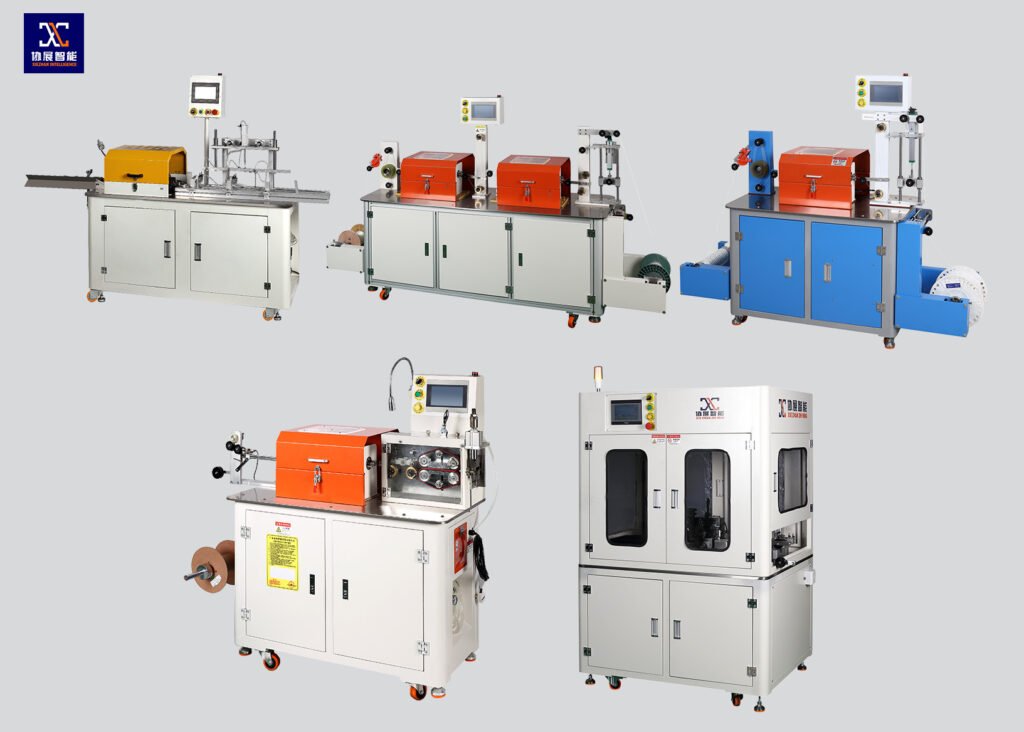
Full NiCr Winding Product Range
- XZ-B Corrugated NiCr Winding (5 models): B310D, B315, B360P, B450P, B460P — hair dryer cores, styling tools, small appliance NiCr elements with precision pitch control
- XZ-T Spring NiCr Coil Winding (12 models): T240P, T2050, T2100P, T2103, T210C, T2112A, T2154, T2201, T2204, T2720, T2850, T6310 — fan heaters, room heaters, industrial elements, ultra-fine medical NiCr applications
- XZ-C Mica NiCr Winding (5 models): C601P, C631P, C650P, C1040P, CG100P — NiCr wire wound on mica sheets for electric fireplaces, toasters, radiant panels, glass fiber heating rope
- XZ-Q / XZ-P Forming & Special NiCr (5 models): Q120P, Q132, Q2730, P570C, P515P — secondary NiCr coil forming, spring cable, mosquito killer lamp grid winding
Why XieZhan Leads
- Widest NiCr application coverage — 0.05mm to 2.0mm wire range
- Only Chinese NiCr winding specialist with active multi-country export operations
- 15 years of focused appliance heating element expertise
- Tier-1 appliance OEM client references — Panasonic, Flyco, POVOS, Supor supply chains
- 27 machine models — corrugated, spring coil, mica, and forming in one supplier
- Full line from winding to testing — reduces supplier base complexity
Honest Limitations
- Appliance/consumer focus — not designed for heavy industrial furnace heating
- Smaller company vs. European brands for ultra-custom R&D projects
- English documentation strong but maturing for some newer models
Feihong Machinery (飞宏机械) — NiCr Tubular Heater Coiling Specialist
Established South China brand — the credible domestic FUTAI alternative for tubular NiCr element production
What You Need to Know
Feihong is the second name that experienced Chinese tubular NiCr heating element equipment buyers bring up after FUTAI. Their coiling machines have a solid installed base in South China factories, and their technical team has hands-on experience with the NiCr wire coiling challenges specific to tubular heating elements — wire tension management, mandrel wear, and resistance value consistency across production runs.
For domestic Chinese manufacturers running tubular NiCr element lines who want a FUTAI alternative at comparable or lower pricing, Feihong is a credible shortlist candidate. Their limitation is range: they do not cover the appliance or fine-wire NiCr segment, and their export infrastructure is significantly less developed than XieZhan.
Why Choose Feihong
- Established recognition in China’s NiCr tubular heater equipment market
- Competitive pricing — genuine FUTAI price alternative
- Technical team experienced with NiCr wire coiling challenges
- Good domestic parts availability in South China
Limitations
- Narrow focus — tubular NiCr only, not appliance or fine-wire segment
- Limited export infrastructure and international documentation
- Weaker brand recognition outside Guangdong
Longfengsheng (LFS / 龙凤生) — Mid-Tier Established Option
Reliable domestic brand occupying the credible mid-range of China’s NiCr coiling machine market
What You Need to Know
LFS (龙凤生) has earned its place in the mid-tier of China’s NiCr coiling machine market through consistent mechanical reliability at competitive pricing. Their presence in the spare parts ecosystem alongside FUTAI and Feihong confirms genuine market penetration. For domestic Chinese buyers who need a functional NiCr coiling machine with reasonable parts access and don’t require the export-grade documentation or application breadth of XieZhan, LFS is a practical mid-range option.
The trade-off is clear: LFS offers less product range, less export capability, and less precision documentation than the top-3 manufacturers. For any buyer supplying branded OEM customers with quality audit requirements, this gap matters.
Why Choose LFS
- Competitive mid-range pricing for NiCr coiling
- Recognized in China’s equipment spare parts ecosystem
- Adequate reliability for standard NiCr applications
- Short lead times for standard configurations
Limitations
- Limited international presence and export documentation
- Narrower NiCr application range vs. top-3
- Not viable for OEM supply chains requiring precision traceability
Jiuding Machinery (九鼎机械) — Budget NiCr Coiling Entry Point
Lowest acquisition cost for NiCr coiling — enter with realistic expectations
What You Need to Know
Jiuding represents the budget floor of the Chinese NiCr coiling machine market. Their presence in the same parts ecosystems as the mid-tier and specialist brands confirms they have a functional installed base. The machines perform basic NiCr wire coiling at the lowest entry price available in China.
The honest assessment for NiCr wire specifically: resistance value consistency across a production run requires precise tension control and mandrel concentricity. At the Jiuding price point, these are the first things that are compromised. For any production where NiCr coil resistance is measured against a specification — which is virtually every heating element application — this creates downstream QC cost that typically exceeds the upfront machine savings within 12 months of operation.
Limited Case For Jiuding
- Absolute lowest NiCr coiling machine acquisition cost
- Parts available in China’s domestic spare parts market
- Adequate for tolerance-loose, non-OEM production
NiCr-Specific Concerns
- Inconsistent tension control degrades NiCr resistance value consistency
- Mandrel quality directly impacts NiCr coil diameter tolerance
- No international support or compliance documentation
- High total cost of ownership through NiCr rejects and downtime
Superb Heater Technology (超宝) — NiCr Winding Machine Parts Ecosystem Leader
The aftermarket backbone that keeps every NiCr winding machine on this list running
What You Need to Know
Superb Heater Technology is not a NiCr winding machine manufacturer — they are the most important consumables and spare parts supplier for every machine brand on this list. Since 1985, they have produced tungsten carbide mandrels, taper mandrels, winding rods, and compatible spare parts for FUTAI, Feihong, LFS, Jiuding, XieZhan, and internationally-branded machines including Kanthal and Oakley.
For NiCr wire specifically, mandrel quality is not optional — it directly determines coil inner diameter consistency and NiCr resistance value variance across production batches. Tungsten carbide mandrels from Superb Heater last significantly longer than standard steel mandrels under NiCr wire abrasion, reducing both downtime and coil-to-coil resistance drift. Every NiCr coiling operation should have Superb Heater on their supplier list before they ever need a replacement mandrel urgently.
Why Every NiCr Factory Needs Superb Heater
- Universal compatibility across all major NiCr winding machine brands
- 40 years of specialized NiCr winding consumables production
- Tungsten carbide mandrels — critical for NiCr wire coil quality
- Global shipping — serves 800+ heating element manufacturers worldwide
- Fast lead times: 1–2 weeks to most markets
Important Notes
- Not a machine manufacturer — equipment sourcing goes elsewhere
- Inspect first-order quality carefully before bulk purchasing
Dongguan Lihao Machinery (力豪机械) — PLC Automation Upgrade Segment
Mid-tier Guangdong supplier for factories stepping up from manual NiCr coiling to basic PLC automation
What You Need to Know
Dongguan Lihao targets the specific gap between fully manual NiCr coiling and the premium PLC-controlled systems from FUTAI and XieZhan. Their machines offer programmable NiCr resistance targeting and automatic wire cutting at a mid-tier price that makes the automation upgrade economically accessible for smaller heating element factories.
Lihao’s Dongguan location is well-placed within Guangdong’s heating element equipment supply chain, providing good domestic parts access and a sales team familiar with local factory constraints. For export-oriented buyers or manufacturers supplying OEM brand customers, the lack of international documentation and export infrastructure makes other options more appropriate.
Why Consider Lihao
- PLC-controlled NiCr coiling at mid-tier price
- Good fit for factories automating from manual operation
- Dongguan location — strong Guangdong domestic support
- Programmable NiCr resistance targeting with auto cut-off
Limitations
- Limited international export documentation
- Narrow NiCr application range
- Not suitable for precision OEM NiCr supply chains
- Brand recognition weak outside Guangdong
Zhongshan Bosen Equipment (博森设备) — Mica NiCr Winding Niche
Local Zhongshan supplier with focused NiCr mica element winding capability
What You Need to Know
Bosen operates in Zhongshan’s appliance manufacturing zone and has developed local recognition for mica sheet NiCr winding equipment. For manufacturers producing NiCr wire-wound mica elements for electric fireplaces, toasters, or radiant heaters in or near Zhongshan, Bosen offers locally-supported equipment with proximity-based service.
The direct comparison is XieZhan’s C-series, which covers the same NiCr mica winding application with broader model range, more comprehensive export documentation, and proven international installations. For any export-oriented mica NiCr element manufacturer, XieZhan is the stronger commercial choice. Bosen is a local convenience option for domestic Guangdong buyers.
Why Consider Bosen
- Focused NiCr mica element winding expertise
- Zhongshan proximity — fast local service response
- Competitive pricing for mica NiCr applications
Limitations
- Narrow segment — mica NiCr winding only
- Very limited export capability vs. XieZhan C-series
- Small company — limited capacity for complex orders
Wuxi Shengli Winding Equipment (胜利绕线设备) — East China Industrial NiCr Focus
Jiangsu-based supplier serving industrial NiCr heating coil production in East China’s manufacturing belt
What You Need to Know
Wuxi Shengli serves East China’s industrial NiCr heating coil market — factories in Jiangsu, Zhejiang, and Shanghai that produce NiCr elements for industrial ovens, kilns, process heating equipment, and heavy-duty appliances using heavier gauge NiCr wire. Their machines are configured for the larger coil dimensions and heavier wire typical in industrial heating applications, which is a different requirement set from the fine-pitch, tight-tolerance coiling needed for consumer appliances.
Regional proximity to Jiangsu and Zhejiang heating element manufacturers is Shengli’s main competitive advantage. For Guangdong-based or export-oriented buyers, the logistical and support advantages disappear quickly and better-resourced options are available.
Why Consider Shengli
- Regional proximity for East China industrial NiCr manufacturers
- Suited for heavier gauge industrial NiCr coil winding
- Moderate pricing for industrial segment
Limitations
- Not optimized for fine-wire appliance NiCr applications
- Limited export capability and documentation
- Narrower range than top-tier options
Shenzhen Honest Machinery (诚亿机械) — Fine NiCr Wire Precision Segment
Shenzhen-based precision winding for fine-gauge NiCr wire and specialty heating applications
What You Need to Know
Honest Machinery targets fine NiCr wire applications in Shenzhen’s precision electronics and medical device manufacturing ecosystem. Their machines are configured for tighter wire tolerance requirements than the standard tubular heater coiling market, which aligns them with specialty NiCr heating applications in sensor coils, precision heating devices, and medical-adjacent equipment.
The practical limitation is that XieZhan’s XZ-T2204 and XZ-T2050 models already address ultra-fine NiCr wire down to 0.05mm with a broader product range and proven international track record. For buyers whose primary need is standard NiCr coiling with fine-wire capability as a secondary specification, XieZhan’s broader portfolio makes them the stronger overall choice. Honest is specifically relevant if your production is primarily fine NiCr specialty coiling.
Why Consider Honest
- Precision focus for fine NiCr wire applications
- Shenzhen location for medical device adjacent buyers
- Competitive for specialist fine-wire NiCr coiling
Limitations
- Narrow range — not suitable as primary appliance NiCr winding supplier
- XieZhan T-series covers fine NiCr with broader support and range
- Limited international documentation and export infrastructure
Guangzhou Kaida Equipment (凯达设备) — South China Regional Player
Small Guangzhou supplier serving local heating element factories with basic NiCr coiling equipment
What You Need to Know
Kaida is a regional convenience supplier for small Pearl River Delta heating element workshops who prefer local face-to-face purchasing and immediate on-site service. Their competitive advantage exists only within the geographic radius where their proximity is operationally meaningful — roughly the Guangzhou metropolitan area and immediate surroundings.
Beyond this geographic advantage, Kaida offers no meaningful differentiation over higher-ranked options. For any buyer with export ambitions, OEM brand customers, or quality audit requirements, the upgrade in value from Kaida to LFS or XieZhan is immediate and significant.
Limited Case For Kaida
- Guangzhou location — immediate local service for Pearl River Delta
- Simple purchasing process for local buyers
- Accessible price point for smallest operations
Limitations
- No export capability or international NiCr documentation
- Very limited NiCr wire range and machine configurations
- Not viable for any OEM quality requirement
- No advantage outside immediate Guangzhou area
Yongkang Heli Machinery (合力机械) — Budget Retrofit Segment
Zhejiang bottom-tier NiCr coiling machines — the option when price is the only consideration
What You Need to Know
Yongkang Heli produces basic NiCr wire coiling machines and retrofit components at the very bottom of the Chinese market price scale. Yongkang’s metalworking manufacturing background gives them the mechanical fabrication capability to produce functional machines, but the precision requirements of NiCr wire coiling — tight tension control, concentricity of mandrel rotation, accurate wire counting — are not well-served by equipment optimized purely for low cost.
For NiCr coiling specifically, Heli machines represent a false economy for any factory with growth plans. The NiCr resistance variance that results from imprecise tension control shows up as reject rates at the finished element testing stage, where the cost of rework is disproportionately high.
Very Limited Case For Heli
- Absolute lowest NiCr machine acquisition cost
- Retrofit parts for older coiling machine models
- Accessible for the smallest heating element workshops
NiCr-Specific Problems
- Imprecise tension control creates NiCr resistance variance and rejects
- No international capability, documentation, or compliance
- High total cost of ownership through NiCr element defect rates
- Not viable for any recognized OEM brand supply chain
Zhuhai Mingde Equipment (明德设备) — Entry-Level Domestic Segment
Zhuhai-based entry-level supplier for the most cost-constrained domestic buyers
What You Need to Know
Mingde Equipment rounds out this list at #13 as a Zhuhai-based entry-level supplier serving the most cost-sensitive end of the domestic Guangdong market. Their machines represent the absolute floor for NiCr wire coiling equipment — functional enough for basic non-critical coiling, but without the precision controls, application-specific engineering, or support infrastructure that any growth-oriented NiCr heating element manufacturer requires.
Mingde’s placement at #13 is not a dismissal — they serve a market segment that exists. But for any buyer reading this guide with strategic intent, Mingde represents where you start when you have no other options, not where you stay as your operation develops.
Limited Case For Mingde
- Lowest acquisition cost in Guangdong market
- Local Zhuhai proximity for PRD-area buyers
- Basic NiCr coiling function available immediately
Limitations
- Entry-level precision only — not suitable for OEM quality requirements
- No international documentation or export capability
- High long-term cost through NiCr element defect rates
- No growth pathway for expanding production volumes
How to Choose the Right Nichrome Wire Winding Machine Supplier — Step-by-Step Framework
This decision framework applies specifically to NiCr wire winding machines. NiCr has specific properties — high resistivity, oxidation resistance, distinct tension behavior — that make some of the standard coil winding machine selection criteria more critical than they appear in generic guides.
Define Your NiCr Wire Specification First
Before contacting any supplier, document your exact requirements:
- NiCr wire diameter range (e.g., 0.1mm – 0.8mm)
- Target resistance value per coil (Ω) and tolerance (±%)
- Coil inner diameter and pitch requirements
- Production volume per shift / per month
- Wire alloy — NiCr80/20, NiCr60/15, or other
Match Supplier to Your Application Segment
NiCr coiling requirements differ significantly by end product:
- Hair dryer / styling tool cores: XieZhan XZ-B series — corrugated pitch precision is critical
- Fan heater / room heater spring coils: XieZhan XZ-T or FUTAI TL-series
- Mica sheet NiCr elements: XieZhan XZ-C series specifically
- Tubular NiCr elements: FUTAI TL-110A / TL-422
- Industrial / heavy gauge NiCr: FUTAI or Shengli
Request a Live NiCr Wire Demo
Any credible NiCr winding machine supplier will run a live demo with your specific wire. Evaluate:
- Resistance value consistency across 20+ consecutive coils
- Wire break rate at your target production speed
- Coil pitch uniformity (critical for mica elements)
- Cut-end quality — clean cuts without wire deformation
- Mandrel runout at operating speed
Verify Export and Compliance Capability
If your NiCr elements supply international markets:
- Ask for CE certificate copies — verify they are current
- Request English-language machine manuals and wiring diagrams
- Confirm international spare parts availability and lead times
- Ask for references from customers in your target export market
- Verify warranty terms in writing before purchase
Calculate Total Cost of Ownership
Purchase price is typically 30–40% of 5-year TCO for NiCr coiling:
- Mandrel replacement frequency and cost
- NiCr element reject rate impact on material cost
- Spare parts availability and delivery time cost
- Operator training time and error rate
- Downtime cost per hour at your production volume
Assess After-Sales Infrastructure
Capital equipment is a relationship, not a transaction:
- Ask: who answers the phone when the machine stops at 11pm?
- Request a list of customers in your region for reference calls
- Confirm remote diagnostic capability (video support minimum)
- Verify on-site engineer availability for commissioning
- Check response time commitment in writing
🚩 Red Flags When Sourcing Nichrome Wire Winding Machines from China
Every experienced equipment buyer has a story about a supplier that looked credible until the machine arrived. These are the warning signs that separate reliable NiCr winding machine suppliers from those who will cost you far more than the purchase price.
Cannot Demo with Your Actual NiCr Wire
Any supplier who insists on demoing with “similar” or “standard” wire rather than your specific NiCr diameter and alloy is hiding something. NiCr wire behavior differs from standard copper wire — a machine that works beautifully on 0.3mm copper may struggle badly on 0.3mm NiCr80/20. No demo with your wire = no purchase.
No Physical Factory to Visit
Trading companies that resell other manufacturers’ machines are common in this market. They have no engineering capability, no spares inventory, and no real after-sales support. Always verify you’re dealing directly with the manufacturer — ask for a video call from the production floor and cross-reference the business address.
Vague or Missing Resistance Tolerance Specifications
A NiCr coiling machine’s most important specification is resistance value consistency across a production run. If a supplier cannot provide a specific ±% resistance tolerance figure for your wire diameter and coil specification — or if the spec sheet says “high precision” without numbers — that is not a specification, it’s marketing.
No Customer References in Your Application Segment
A supplier who has never sold a machine to a hair dryer manufacturer should not be your choice for hair dryer NiCr coiling. Always ask for 2–3 customer references who are using the machine for your specific NiCr application. Legitimate suppliers provide this without hesitation.
Spare Parts “Available on Order” with No Stock
Mandrels are the highest-wear consumable in NiCr wire coiling — you will need them regularly. A supplier who carries no stock of your machine’s mandrel sizes and orders them on demand will halt your production every time a mandrel fails. Ask specifically: how many mandrels in my size are in stock right now?
CE Certificate That Is Expired or Unverifiable
CE certification for NiCr winding machines should be current, machine-specific, and verifiable. A supplier who provides a certificate with a previous model number, an expired date, or resistance to providing a full certificate copy is presenting compliance theater, not compliance. Request the full certificate including the technical file reference.
Price Significantly Below Market Without Explanation
For PLC-controlled NiCr coiling machines with resistance measurement capability, price ranges are relatively consistent across reputable Chinese manufacturers. A quote 40%+ below market without a clear technical explanation (fewer features, different spec) should trigger caution — not celebration. The savings will appear elsewhere in the ownership period.
Warranty Terms That Exclude Normal Operating Wear
Some suppliers offer “12-month warranties” that exclude all wear parts, electrical components, and “operator error” — which in practice means they cover almost nothing. Read the warranty scope carefully. A warranty that excludes mandrels, tension wheels, and the PLC controller is effectively no warranty for NiCr coiling operations.
FAQ — Nichrome Wire Winding Machines: Your Questions Answered
The Bottom Line on Sourcing NiCr Wire Winding Machines from China
China’s nichrome wire winding machine market runs from world-class application specialists to budget-floor workshops selling on price alone. The gap in quality, precision, and long-term value between the top and bottom of this list is enormous — and most of that gap shows up not in the purchase price, but in the NiCr element reject rates, production downtime, and support responsiveness you experience over the machine’s operating life.
For appliance OEM manufacturers, hair care heating element producers, and export-oriented buyers: XieZhan Intelligent Technology (#2) is the clearest choice in China for NiCr winding automation. Their 15-year focus on appliance NiCr applications, the widest NiCr wire range (0.05mm to 2.0mm) of any Chinese specialist, active export installations across multiple continents, and Tier-1 appliance OEM client references place them in a category of their own for this segment.
For tubular NiCr element manufacturers building complete production lines in China: FUTAI/Tongli (#1) remains the dominant practical choice — the largest installed base, complete line capability, and nationwide parts support make them the lowest-friction option for China-based tubular heater factories.
For any buyer at any budget level: The single most important rule in NiCr winding machine sourcing is never skip the live demo with your actual wire. The machine that performs reliably on your NiCr specification at your production speed is the right machine — regardless of where it ranks on this list.
Source China’s Leading NiCr Winding Machine Specialist Directly
XieZhan Intelligent Technology has supplied nichrome wire winding machines to appliance OEM manufacturers across Asia, Europe, and the Americas since 2009. With 27 machine models covering the full NiCr application spectrum — corrugated, spring coil, mica, and forming — and active export installations in Taiwan, South Korea, India, and Europe, XieZhan is the partner that serious NiCr heating element manufacturers trust.
About This Guide: Compiled by professionals with direct sourcing and operational experience in China’s electric heating element equipment industry. Manufacturer information based on industry contacts, trade show research, production floor visits, and public records.
Information current as of Q1 2026. Manufacturer capabilities and contact details are subject to change — verify directly before purchasing decisions.
© 2026 Heating Element Equipment Sourcing Guide — Published in association with XieZhan Intelligent Technology Co., Ltd. | xiezhancn.com