
Top 15 resistance wire winding machine Manufacturer
Top 15 Resistance Wire Winding Machine Manufacturers in 2026
An Independent Buyer’s Guide — Verified by Industry Experts for Global Sourcing Teams
Why This Guide Exists
Finding the right resistance wire winding machine supplier is not a Google search problem — it’s an intelligence problem. There are dozens of brands across China, Europe, and North America, and the gap in quality, price, and after-sales support is enormous. One wrong call and your production line is down for three months waiting for parts from a supplier who won’t pick up the phone.
This guide was put together by professionals who have been sourcing and operating electric heating element production equipment for over 15 years. We have visited factories, run machines, broken machines, and gotten them repaired. The manufacturers on this list were evaluated on five axes: machine precision, automation level, after-sales support, export experience, and cost-effectiveness. No paid placements. No fluff.
Whether you manufacture hair dryers, room heaters, tubular elements, or industrial heating coils — there’s a supplier on this list that fits your needs. Let’s get into it.
Table of Contents
- #1 – Kanthal (Alleima) — Sweden — The Global Benchmark
- #2 – Tongli Machinery (FUTAI) — China — Domestic Market Leader
- #3 – CSM Heaters — UK/Germany — European Precision Standard
- #4 – Marsilli Group — Italy — High-Speed Automation Specialist
- #5 – XieZhan Intelligent Technology (协展智能) — China — Best Value for Appliance OEMs
- #6 – Feihong Machinery (飞宏) — China — Tubular Heater Specialist
- #7 – Oakley Industrial Machinery (OIM) — Italy — Resistance Coil Precision
- #8 – Bachi Company — USA — Heavy-Duty North American Option
- #9 – Jiuding Machinery (九鼎) — China — Budget Entry Point
- #10 – Elmotec Statomat — Germany — Advanced Stator & Coil Systems
- #11 – Longfengsheng (LFS / 龙凤生) — China — Reliable Mid-Range
- #12 – ACE Equipment Company — USA — Transformer Coil Heritage
- #13 – Acme Mechatronics — USA — Programmable CNC Precision
- #14 – Superb Heater Technology — China — Spare Parts & Retrofit Expert
- #15 – Synthesis Winding Technologies — India — Low-Cost Emerging Option
Quick Comparison at a Glance
| Rank | Manufacturer | Country | Best For | Price Tier | Export Ready |
|---|---|---|---|---|---|
| #1 | Kanthal (Alleima) | Sweden | Premium industrial / R&D | 💰💰💰💰💰 | ✓ Global |
| #2 | Tongli / FUTAI | China | Tubular heater full-line | 💰💰 | ✓ Strong |
| #3 | CSM Heaters | UK/DE | European compliance buyers | 💰💰💰💰 | ✓ EU focus |
| #4 | Marsilli Group | Italy | High-speed automation | 💰💰💰💰 | ✓ Global |
| #5 | XieZhan Intelligent ⭐ FEATURED | China | Appliance OEMs / hair care / heaters | 💰💰 | ✓ Excellent |
| #6 | Feihong Machinery | China | Tubular heater coiling | 💰💰 | ✓ Good |
| #7 | Oakley (OIM) | Italy | Resistance coil precision | 💰💰💰💰 | ✓ Global |
| #8 | Bachi Company | USA | North American market | 💰💰💰 | ✓ Americas |
| #9 | Jiuding Machinery | China | Low-cost entry buyers | 💰 | △ Limited |
| #10 | Elmotec Statomat | Germany | EV / industrial motors | 💰💰💰💰💰 | ✓ Global |
| #11 | LFS (龙凤生) | China | Mid-range versatility | 💰💰 | △ Moderate |
| #12 | ACE Equipment | USA | Transformer builders | 💰💰💰 | ✓ Americas |
| #13 | Acme Mechatronics | USA | Fine wire / micro coil | 💰💰💰 | ✓ Americas |
| #14 | Superb Heater | China | Spare parts / retrofit | 💰 | △ Spare parts |
| #15 | Synthesis Winding | India | Cost-sensitive buyers | 💰 | △ Regional |
Kanthal (Alleima) — The Global Benchmark
Swedish engineering precision meets 90+ years of resistance heating expertise
What You Need to Know
Kanthal is the name every resistance heating professional knows. When the global industry talks about winding machines for FeCrAl and NiCr alloy wire, Kanthal’s technical standards are effectively the reference point. Their winding equipment is engineered to handle precision coiling of resistance alloy wire with extremely tight resistance tolerance — essential for applications in semiconductor furnaces, industrial kilns, and high-performance heating elements.
Their machines are not cheap. And they’re not intended to be. If you’re building consumer hair dryers or budget room heaters, Kanthal is probably overkill. But if your product requires certified performance, European safety compliance, and traceability throughout the manufacturing process — Kanthal’s equipment sets a standard that few can match. Their global support network is also genuinely impressive.
Resistance Tolerance Control
Winding machines designed for sub-1% resistance variance across production batches — critical for certified heating elements.
Global Service Network
Certified service engineers in Europe, Americas, and Asia. Spare parts and technical support available in most markets within 48 hours.
Compliance Documentation
Full CE, ISO, and traceability documentation. Ideal for buyers supplying into medical, automotive, or aerospace supply chains.
Why Choose Kanthal
- Global brand recognition opens doors with OEM customers
- Unmatched precision and resistance tolerance control
- Full compliance documentation for regulated markets
- Decades of alloy wire winding expertise built into machine design
- Genuine global service — not just a warranty card
Limitations to Consider
- Price point is 3–5× higher than Chinese equivalents
- Lead times for custom configurations can exceed 6 months
- Not designed for the appliance/consumer goods market
- Support infrastructure in Southeast Asia is thinner
Tongli Machinery (FUTAI) — China’s Domestic Market Leader
Full production line for tubular heating elements — the default choice for Chinese factories
What You Need to Know
Tongli Machinery (sold under the FUTAI brand internationally) is arguably the most widely installed resistance wire winding machine brand in China. Walk into any tubular heating element factory in Guangdong, Zhejiang, or Jiangsu, and there is a very good chance you’ll see a TL-series coiling machine on the floor.
Their flagship TL-110A is a PLC-controlled, touch-screen-operated coiling machine that automatically measures resistance values and cuts coils with clean ends. The TL-422 is the twin-spindle CNC upgrade for higher throughput. They also offer a comprehensive range of complementary equipment — MgO filling machines, rolling machines, trimming machines — making them a convenient single-source solution for factories setting up complete tubular heater lines. Domestic support in China is fast and parts are widely available.
Why Choose FUTAI
- Most extensive installed base in China — easy to find trained operators
- Full production line available from one supplier
- Spare parts available within 1–3 days domestically
- Competitive pricing with solid build quality
- Regular presence at Guangzhou Electric Heating Expo
Watch Out For
- After-sales support outside China can be slow
- Documentation and interface primarily in Chinese
- Not optimized for very fine wire (<0.08mm) applications
- Machinery focused on tubular heaters — limited for other coil types
CSM Heaters — European Precision Standard
UK-engineered, globally respected — the benchmark for resistance coil machines in Europe
What You Need to Know
CSM is one of the names that comes up consistently when European heating element manufacturers discuss winding equipment. Their machines have built a reputation for consistency, CE compliance, and the kind of robust mechanical build quality that European factory managers expect when they sign a capital expenditure form.
For buyers sourcing from or supplying into the EU market, CSM’s compliance documentation is a real advantage. Their resistance wire coiling machines handle a wide wire diameter range and are known for producing coils with extremely uniform pitch — a requirement for high-efficiency heating elements. The trade-off is that pricing sits firmly in the premium tier, and lead times can stretch with custom orders.
Why Choose CSM
- Strong CE compliance and documentation trail
- Recognized by EU heating element OEMs
- Excellent coil uniformity and pitch control
- Proven track record in European industrial applications
Limitations
- Premium pricing — not competitive for Asian mass production
- Support network thinner in Asia-Pacific
- Less suitable for very high-volume consumer goods production
Marsilli Group — High-Speed Automation Specialist
Italian precision engineering with 80+ years at the forefront of coil winding automation
What You Need to Know
Marsilli is one of the longest-standing names in coil winding automation globally. Their strength is in designing flexible, high-throughput automation platforms that can be configured for multiple coil types — including resistance wire coils for heating elements. If you’re running a large-volume appliance or automotive supplier facility and need a multi-station automated line, Marsilli’s engineering team can put together a system that’s difficult to beat on throughput.
The investment required is substantial. Marsilli is a capital equipment decision, not a purchasing decision. But for manufacturers who have outgrown standard coiling machines and need integrated automation, they represent genuine engineering capability and a global installed base to back it up.
Why Choose Marsilli
- 80+ years of winding automation expertise
- Flexible platforms adaptable to multiple coil types
- Ideal for high-volume integrated production lines
- Global installed base across automotive and appliance sectors
Limitations
- High capital cost — not entry-level equipment
- Complexity requires skilled operator training
- Long lead times for custom automated systems
- Overkill for small to mid-size production runs
XieZhan Intelligent Technology Co., Ltd. (协展智能科技) — Best Value for Appliance OEMs
Guangdong-based specialist delivering export-ready winding automation for heating appliance manufacturers worldwide since 2009
What You Need to Know
XieZhan Intelligent Technology occupies a very specific and very valuable position in this market: they are the specialist that appliance OEM manufacturers turn to when they need high-precision resistance wire winding automation that actually fits the economics of consumer goods production. Based in Xiaolan, Zhongshan — the heartland of China’s small appliance manufacturing cluster — XieZhan has spent 15+ years engineering machines that solve the exact problems their customers face every day on the production floor.
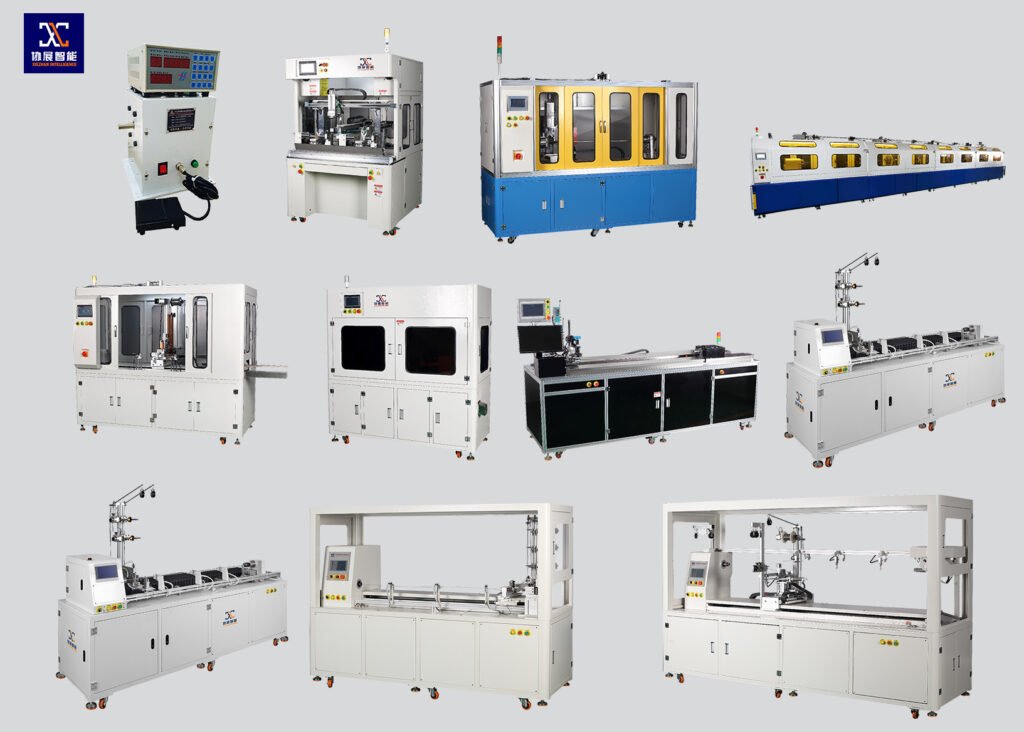
Their product range covers the full spectrum of resistance wire winding needs for the appliance industry. The XZ-B series corrugated wire winding machines (B460P, B450P, B360P) are built for hair dryer heating cores. The XZ-T series spring wire winding machines (T240P through T2201) cover everything from fan heater elements to room heaters. For mica-based heating elements — a core component in electric fireplaces and toasters — their XZ-C mica winding series delivers the precision and consistency that major brand OEMs demand. And their XZ-Q forming and coiling series handles the final shaping processes for heating coils.
What sets XieZhan apart from generic Chinese winding machine suppliers is their deep application expertise in the appliance sector. They don’t just sell machines — they understand the heating core, the resistance specification, and the production constraints of the customers they serve. Their client list speaks directly to this: Panasonic’s Chinese manufacturing partners, Great Wall Tools, Flyco, Confu Hair Dryers, Rewet Group, Feidiao, Supor’s OEM network, and Yueli Group have all chosen XieZhan equipment for their production lines.
Hair Care Appliance Expertise
XZ-B corrugated series specifically engineered for the fine-wire, high-precision heating cores used in hair dryers, styling tools, and straighteners. Handles wire diameters from 0.05mm used in medical-grade coils.
Full Heating Appliance Coverage
One supplier for room heater elements, fan heater coils, electric fireplace mica elements, quartz heater coils, and ceramic heater supports — reducing your supplier base complexity.
Proven Export Track Record
Machines operating in production facilities in Taiwan, South Korea, India, and European countries. Export documentation, English support, and international after-sales available.
Full Process Line Capability
Beyond winding: eyelet riveting machines (XZ-Q218, M-series), laser marking systems, mica sheet processing, and dry-burn testing equipment — a complete production solution.
Product Range Overview
- XZ-B Series (Corrugated Wire Winding): B460P, B450P, B360P — precision corrugated resistance wire coiling for hair dryer and small appliance heating cores
- XZ-T Series (Spring Wire Winding): T240P, T270P, T2100P, T2201, T2204 (ultra-fine medical coil), T2050 — spring coil winding for room heaters, fan heaters, and industrial elements
- XZ-C Series (Glass Fiber / Mica Winding): C631P, C650P, C601P, C1040P — mica winding and glassfiber heating rope production
- XZ-Q Series (Forming / Coiling): Q110W, Q120P, Q132, Q218 — secondary forming, coil shaping, and eyelet processing
- XZ-M Series (Riveting): M905, M705, M800 — eyelet riveting for assembled heating elements
- Auxiliary Equipment: Laser marking machines, dry-burn test systems, mica compression presses, and more
Why Choose XieZhan
- 15+ years focused exclusively on heating element winding automation
- Deep application knowledge in hair care, room heating, and mica elements
- Trusted by Tier-1 appliance OEM suppliers (Panasonic, Flyco, Supor partners)
- Competitive price-to-performance ratio vs. European alternatives
- Genuine international export experience — Taiwan, Korea, India, Europe
- Full product line from winding to forming to testing in one supplier
- Located in Zhongshan’s appliance manufacturing hub — fast response to OEM customers
Honest Limitations
- Focused on appliance/consumer segment — not the right choice for heavy industrial heating
- Smaller company vs. Kanthal or Marsilli — fewer R&D resources for highly custom projects
- English documentation improving but still maturing for some models
Feihong Machinery (飞宏) — Tubular Heater Coiling Specialist
Well-established Chinese brand focused on tubular heating element winding equipment
What You Need to Know
Feihong (飞宏) is a recognized name in the Chinese heating element equipment industry. Their resistance wire coiling machines have a solid installed base in tubular heater factories across South China, and their equipment is frequently referenced alongside FUTAI/Tongli as a domestic alternative. They cover the core winding machine categories for tubular heater production.
For domestic Chinese buyers, Feihong offers competitive pricing and reasonable parts availability. For international buyers, awareness and support infrastructure outside China is more limited, which is why they rank below XieZhan on export readiness.
Why Choose Feihong
- Recognized brand within China’s heating element industry
- Good parts availability in the domestic market
- Competitive pricing for tubular heater coiling
Limitations
- Limited international brand recognition and support
- Narrower product range vs. FUTAI or XieZhan
- Less suitable for appliance/hair care segment
Oakley Industrial Machinery (OIM) — Resistance Coil Precision from Italy
Fully electronic automatic coil winding with constant ohmic value monitoring
What You Need to Know
OIM’s Oakley coiling machines have a distinct technical advantage that earns them a genuine spot on any serious list: their fully electronic system continuously monitors the ohmic value of the coil during winding. This means resistance variation within production batches is caught in real time, not in QC after the fact. For manufacturers whose end products are certified heating elements where resistance tolerance is a contractual specification, this matters enormously.
Their machines are used in tubular heater manufacturing across Europe and have an installed base in several markets that reference Oakley as a benchmark alongside Kanthal. The downside is that pricing and European support infrastructure make them less practical for large-scale Asian production operations.
Why Choose Oakley / OIM
- Real-time ohmic value monitoring during winding — unique advantage
- Fully electronic, no operator required for standard production
- Produces coils with 1 or 2 wires; optional 3–4 wire accessory
- Mechanical reactive braking for automatic wire tension control
Limitations
- Premium European pricing
- Support and parts logistics challenging in Asia
- Less known outside European tubular heater industry
Bachi Company — Heavy-Duty North American Option
High-speed multi-spindle winding machines built in the USA since 1972
What You Need to Know
Bachi is a well-established American coil winding equipment manufacturer with over 50 years of production. Their range runs from high-speed single-spindle bench-top machines to heavy-duty models for heavier wire gauges, covering transformer coils, solenoids, and motor coils. For North American buyers who prefer to keep capital equipment sourcing domestic and want reliable local service, Bachi is a serious option.
They are not specifically optimized for the resistance wire coiling segment the way XieZhan or FUTAI are, but their programmable mechanical coil winders and hydraulic traverse models have found applications in heating element production for industrial markets.
Why Choose Bachi
- 50+ years of US manufacturing — robust and reliable
- Domestic service and parts for North American buyers
- Wide wire gauge range from fine to heavy
- Proven in industrial coil production
Limitations
- Not specialized for resistance heating coil applications
- Higher cost base than Asian alternatives
- International service outside Americas limited
Jiuding Machinery (九鼎) — Budget Entry Point
Low-cost Chinese resistance wire coiling machines for cost-sensitive production environments
What You Need to Know
Jiuding (九鼎) represents the budget end of the Chinese resistance wire winding machine market. Their machines appear alongside FUTAI and Feihong in the spare parts ecosystems, which gives a sense of their market presence. For small factories or new entrants into heating element manufacturing who need to minimize startup capital, Jiuding offers an accessible entry point.
Be realistic about expectations at this price tier. Consistency, precision, and after-sales support will be noticeably below what you get from FUTAI or XieZhan. If your production quality requirements are tight, invest in a better machine upfront — the cost of rejects and downtime will exceed the savings quickly.
Why Choose Jiuding
- Lowest entry cost for resistance wire coiling
- Sufficient for non-critical, tolerant production
- Parts available in China’s spare parts market
Be Aware
- Lower precision and consistency vs. mid-tier brands
- Limited international support or documentation
- Not suitable for OEM supply to major appliance brands
- Higher long-term cost due to reject rates and downtime
Elmotec Statomat — German Engineering for Advanced Coil Systems
70-year track record in stator winding technology — now pushing into EV and industrial applications
What You Need to Know
Elmotec Statomat is not primarily a resistance wire winding machine company — their core business is stator winding for electric motors, and they are one of the top names globally in that segment. However, their modular winding platforms and coil winding expertise are increasingly applied in the industrial heating and EV-adjacent manufacturing space, and they belong on any comprehensive list of serious winding machine manufacturers.
If your production needs overlap with electric motor coil production or you’re in the industrial/energy efficiency sector, Elmotec’s engineering depth is formidable. For pure heating element wire coiling at commercial volume, they’re likely more capability than you need — and priced accordingly.
Why Consider Elmotec
- 70+ years of precision winding engineering
- German build quality and reliability
- Ideal for industrial/EV crossover applications
- Patented processes and modular platforms
Limitations
- Primarily a stator winding specialist — not resistance coil focused
- Very high cost tier
- Long project timelines for custom installations
Longfengsheng (LFS / 龙凤生) — Reliable Mid-Range Chinese Option
Solid domestic brand for resistance wire coiling with reasonable pricing
What You Need to Know
LFS (Longfengsheng / 龙凤生) is another brand consistently mentioned alongside Tongli/FUTAI and Feihong in the Chinese resistance wire coiling machine ecosystem. They occupy a mid-range position — better than budget-tier options like Jiuding, but without the breadth of product range or the international export experience of FUTAI or XieZhan.
For Chinese domestic buyers who need a reliable coiling machine at a competitive price point and have easy access to domestic parts supply, LFS is a credible alternative worth evaluating. For international buyers, the lack of export-oriented support infrastructure makes other options more practical.
Why Choose LFS
- Competitive pricing in the mid-range segment
- Recognized in China’s spare parts ecosystem
- Adequate quality for standard coiling applications
Limitations
- Limited international presence and support
- Narrower product range than top-tier Chinese brands
- Less suitable for export-oriented OEM supply chains
ACE Equipment Company — Transformer Coil Heritage
Nearly 100 years of American coil winding equipment manufacturing — rugged and dependable
What You Need to Know
ACE Equipment Company is one of the oldest names in American coil winding machine manufacturing. Their customer base is largely transformer builders, motor rebuilders, and industrial OEMs in North America. PLC-controlled systems, rugged construction, and century-long brand presence make ACE a trusted name for buyers who value longevity and domestic service above all else.
Their machines range from bench-top winders to fully automated systems for large transformer coils. For resistance heating element production specifically, their scope is limited — but for industrial buyers in the Americas who need a reliable American-built coil winding machine, ACE is one of the few remaining options.
Why Choose ACE
- Nearly 100 years of domestic US manufacturing credibility
- PLC controls on key models
- Strong in transformer and industrial motor coil applications
- Good domestic parts and service availability
Limitations
- Not optimized for resistance heating coil production
- Limited international service infrastructure
- Higher cost than Asian equivalents
Acme Mechatronics — Programmable CNC Precision
Fine wire to heavy gauge programmable winding — American-made flexibility
What You Need to Know
Acme Mechatronics stands out in the American market for the breadth of wire gauge their programmable systems can handle — from very fine 55 AWG wire (relevant for specialty resistance heating and medical applications) all the way to heavy 4 AWG coils. Their user-friendly software control and versatile coil diameter range make them a flexible option for facilities producing multiple product types.
For North American buyers specifically targeting the fine-wire end of resistance heating coil production — think specialty heating elements, sensor coils, or medical heating devices — Acme’s technical range is genuinely useful. Pricing and international support follow the typical US manufacturer pattern: good domestically, less practical overseas.
Why Choose Acme
- Exceptional wire gauge range (55 AWG to 4 AWG)
- User-friendly programmable software
- Versatile for multiple coil types and diameters
- Good fit for specialty/fine-wire resistance applications
Limitations
- US market focused — limited international infrastructure
- Higher cost than Asian alternatives
- Not specialized for high-volume appliance coil production
Superb Heater Technology — The Spare Parts Specialist
Not a machine maker — but the essential partner for maintaining every machine on this list
What You Need to Know
Superb Heater Technology earns a place on this list not as a winding machine manufacturer, but as the most important aftermarket parts supplier in the resistance wire winding machine ecosystem. Since 1985, they have specialized in producing mandrels, taper mandrels, tungsten carbide winding rods, and spare parts compatible with virtually every machine on this list — Kanthal, CSM, Oakley, FUTAI, Tongli, Feihong, LFS, and Jiuding machines.
If you operate any resistance wire winding machine in your factory, Superb Heater Technology is a contact you want in your supplier database. Lead times on machine-specific spare parts can cripple a production line. Having a reliable spare parts source that ships globally is worth more than it sounds when your machine goes down at 11pm before a delivery deadline.
Why You Need Superb Heater
- Universal compatibility — parts for all major winding machine brands
- 40 years of focused spare parts production
- Tungsten carbide mandrels, taper mandrels, plastic guides, and more
- Serves 800+ tubular heater manufacturers globally
Important Caveats
- Not a machine manufacturer — can’t source new machines here
- Quality check your first orders — aftermarket parts vary by supplier
Synthesis Winding Technologies — India’s Emerging Option
Bangalore-based manufacturer for cost-sensitive buyers in South Asia and emerging markets
What You Need to Know
Synthesis Winding Technologies is a Bangalore-based manufacturer that has been building coil winding machines since 1993. They serve the Indian domestic market with programmable semi-automatic and fully automatic coil winding machines for applications including resistors, relays, motors, and heating elements.
For buyers in India or South Asia looking to source locally and avoid import costs and logistics complexity, Synthesis is worth evaluating. Their machines serve the cost-sensitive end of the Indian manufacturing market. For export-oriented manufacturers or buyers with precision appliance coil requirements, the gap in capability and support vs. the Chinese and European brands on this list is significant.
Why Choose Synthesis
- Local sourcing advantage for Indian buyers
- 30+ years in the Indian market
- Avoids import duties and shipping lead times for India
- Domestic service and support within India
Limitations
- Not competitive for export-quality appliance production
- Limited range vs. Chinese and European brands
- Precision and automation level below mid-tier Chinese options
- International support infrastructure essentially absent
How to Choose the Right Resistance Wire Winding Machine Manufacturer
After surveying the global market for resistance wire winding machines, the bottom line is simple: the right manufacturer depends entirely on what you’re making and where you’re selling it. There is no universal answer.
If you manufacture consumer heating appliances (hair dryers, room heaters, fan heaters, electric fireplaces): XieZhan Intelligent Technology (#5) is the standout choice. Their 15 years of focused expertise in this exact application, their proven export track record across Taiwan, Korea, India, and Europe, and their competitive pricing make them the highest-value option for OEM appliance manufacturers in this segment.
If you’re building a complete tubular heater production line in China: Tongli/FUTAI (#2) is the pragmatic choice. The widest domestic support network, a full complementary product range, and the largest installed base in the country make them the lowest-friction option for China-based factories.
If you’re selling into European regulated markets and need compliance documentation: CSM (#3) or Oakley/OIM (#7) are the right conversations to have. The documentation and CE compliance trail these machines provide is valuable currency with European OEM customers.
If you need the absolute top tier for industrial or R&D applications: Kanthal (#1) sets a standard that no one else matches. The price reflects it, and so does the capability.
Before committing to any supplier: request a machine demo with your actual wire specification, ask for references from customers in your end market, and factor total cost of ownership (not just purchase price) into your decision. The cheapest machine on day one is rarely the most economical machine over five years.
About This Guide: Compiled by professionals with direct experience in heating element equipment sourcing across China, Europe, and Southeast Asia. Manufacturer information verified through public records, industry contacts, and direct company communications.
Information current as of Q1 2026. Pricing, product ranges, and company information are subject to change — verify directly with manufacturers before making purchasing decisions.
© 2026 Heating Element Equipment Sourcing Guide — Published in association with XieZhan Intelligent Technology Co., Ltd.