
Reducing Labor Costs with Automated Mica Processing Machines
Why Automation Creates Lower Manufacturing Costs Than Simply Reducing Labor
Many manufacturers begin looking at automated mica processing machines because labor costs continue to rise. However, experienced factory managers usually discover that labor is only one part of the total production cost. The larger expense often comes from unstable quality, repeated adjustments, material waste and inconsistent production. Automation becomes valuable because it improves the entire manufacturing process rather than replacing operators alone.
Is Reducing Labor Really the Biggest Benefit of Automation?
Many buyers initially compare the number of operators before and after automation. This seems logical, but it overlooks where factories actually lose money. Labor expenses are visible on payroll reports, while production interruptions, rejected components and unstable quality are often hidden inside daily operations.
The reason is simple. Every manual adjustment introduces slight differences in positioning, feeding or cutting. Those small variations accumulate over thousands of mica components, creating additional inspection work, material waste and delayed assembly. These hidden costs frequently exceed the wages saved by reducing one or two operators.
From a mechanical perspective, automation standardizes every movement. Automatic feeding maintains consistent positioning, servo-controlled cutting follows the same programmed path each cycle, and stable tooling minimizes dimensional variation. The result is a production line that behaves predictably throughout the working day instead of depending on individual operator experience.
Factories with the lowest manufacturing cost are rarely those with the fewest employees. They are usually the factories with the most stable production process, because stable processes reduce waste, rework and delivery risk simultaneously.
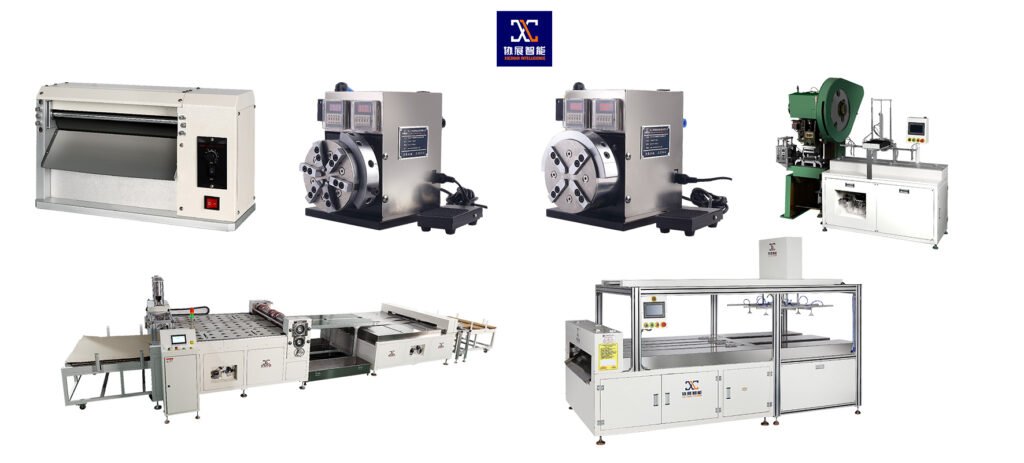
Which Xiezhan Machines Help Build an Automated Mica Processing Line?
Different production stages require different equipment. Instead of purchasing the largest machine available, manufacturers should select equipment according to material size, product structure and production targets. Matching equipment with the manufacturing process creates better long-term efficiency than selecting machines based only on speed.
| Machine Model | Main Function | Key Parameters | Automation Advantage | Typical Application |
|---|---|---|---|---|
| XZ-JB1212 | Automatic mica board cutting |
380VAC 50Hz 3800W 1200×1200mm 0–3mm ±0.2mm | Stable dimensional consistency | Heating element insulation boards |
| XZ-XB1300 | Four-edge trimming & cutting |
5800W 1300×1300mm 0–6mm ±0.2mm | Large-format continuous cutting | Industrial heater insulation panels |
| XZ-SL300 | Automatic stamping & feeding |
220VAC 1800W 30–300mm width | Reduces manual loading | Continuous punching production |
| XZ-J730D | Mica paper roll forming |
220VAC 200W 0.4–1mm | Consistent forming quality | Hair dryer heater production |
Rather than operating as individual machines, these models perform best when integrated into a coordinated production workflow. Each stage prepares the next, reducing unnecessary handling while improving production rhythm.
Manufacturers planning a complete automation upgrade can compare different equipment combinations through our Mica Sheet & Mica Board Processing Machines collection to determine which configuration best fits their production objectives.
Which Production Scenarios Gain the Most from Mica Processing Automation?
Not every factory benefits from automation in the same way. A common misconception is that automation is worthwhile only for very large manufacturers. In reality, the deciding factor is production stability rather than factory size. A medium-sized company producing the same mica components every day may achieve a faster return on investment than a larger factory with constantly changing products.
The reason lies in production rhythm. When product dimensions, material thickness and batch quantities remain relatively consistent, automatic feeding, positioning and cutting systems can maintain continuous operation with minimal intervention. The machine spends more time producing parts and less time waiting for adjustments.
Mechanically, synchronized material handling reduces idle time between operations. Instead of operators transporting workpieces from one process to another, automated equipment keeps materials moving through the line at a controlled pace. The result is shorter production cycles, more predictable scheduling and lower indirect labor costs.
| Production Scenario | Recommended Equipment | Automation Benefit | Labor Saving Potential | Typical Products |
|---|---|---|---|---|
| Electric Heating Elements | XZ-JB1212 + XZ-SL300 | Automatic cutting and feeding | High | Mica insulation sheets |
| Industrial Heaters | XZ-XB1300 | Large-format precision cutting | Medium to High | Large mica boards |
| Hair Dryer Components | XZ-J730D | Continuous roll forming | Medium | Round mica tubes |
| Mixed Heater Production | Combined Production Line | Flexible processing | High | Multiple heater models |
If your operators frequently stop production to adjust fixtures or reposition materials, automation should focus on eliminating these interruptions first. Removing non-productive time often delivers a greater financial return than increasing machine speed.
How Does Automation Improve Quality Control While Reducing Costs?
Quality control is often viewed as a separate department, but in automated manufacturing it begins at the machine itself. The reason is straightforward: a stable process naturally produces stable products. Inspection then becomes verification rather than correction.
From a mechanical standpoint, automatic positioning, controlled cutting force and repeatable feeding reduce dimensional variation before defects occur. Operators spend less time sorting finished parts, while downstream assembly becomes smoother because every mica component fits within specification.
The outcome extends beyond quality. Consistent dimensions reduce scrap, shorten assembly time and lower customer complaint rates, all of which contribute to a lower total manufacturing cost.
| Quality Parameter | Manual Production | Automated Production | Operational Impact | Business Benefit |
|---|---|---|---|---|
| Dimensional Consistency | Operator dependent | Program controlled | Less rework | Lower production cost |
| Material Utilization | Variable | Stable | Reduced waste | Higher yield |
| Inspection Workload | High | Lower | Faster release | Improved efficiency |
| Batch Stability | Inconsistent | Repeatable | Predictable output | Reliable delivery |
Another useful benchmark is to evaluate suppliers based on completed industrial projects rather than equipment specifications alone. Practical implementation experience often determines how quickly a production line reaches stable operation. You can review several real-world cooperation cases on our Client Cooperation page.
How Should Buyers Calculate the Real Return on an Automated Mica Processing Line?
Many investment decisions fail because the calculation starts with equipment price instead of production cost. A lower-priced machine may appear attractive initially, but if it requires frequent adjustments, creates excessive material waste or limits future expansion, the total operating cost becomes much higher over several years.
The correct evaluation follows a simple logic. First identify where production time is being lost. Next determine which machine function eliminates that loss. Finally estimate how much additional qualified output can be produced after the bottleneck disappears. This approach measures operational improvement instead of purchase price alone.
From our project experience, factories generally recover investment faster when automation solves three problems simultaneously: reducing manual handling, stabilizing product dimensions and shortening production interruptions. Those improvements continue creating value every working day without increasing management complexity.
Before requesting quotations, prepare monthly production volume, mica thickness range, finished part drawings, shift arrangement and future capacity targets. These five items allow equipment suppliers to recommend a production line that matches your actual manufacturing conditions instead of providing a generic machine proposal.
Why Does Material Quality Influence Automation Performance?
Even an advanced automated production line cannot completely compensate for inconsistent raw materials. Variations in mica density, thickness tolerance and surface flatness directly affect feeding stability, cutting quality and forming accuracy.
The mechanical reason is straightforward. Automated systems repeat identical movements every cycle. If material dimensions fluctuate beyond acceptable limits, the machine continues operating as programmed, increasing the possibility of dimensional variation or unnecessary waste. Stable materials therefore allow automation to deliver its full performance.
For procurement teams sourcing both equipment and raw materials, understanding reputable suppliers is equally important. Our guide to Top 13 Mica Sheet Manufacturers in China can help compare leading mica material suppliers before planning a complete production line.
Factories with the highest production efficiency usually improve equipment and material quality together. Treating these as one manufacturing system delivers better long-term stability than upgrading only one side of the process.
Conclusion: Automation Should Reduce Process Cost, Not Only Labor Cost
The biggest misconception about automation is that it exists primarily to replace workers. In practice, the greatest value comes from building a production process that remains consistent throughout every shift. Stable positioning, repeatable cutting and coordinated material handling reduce hidden manufacturing costs that are difficult to identify in traditional production.
For manufacturers producing mica insulation components, heating elements and electrical appliance parts, selecting suitable automation should always begin with production objectives rather than equipment specifications. The right machine configuration supports current demand while providing flexibility for future expansion.
If you are evaluating an automated mica processing project, our engineering team can recommend an equipment configuration based on your product drawings, material specifications and target production capacity. Please feel free to Contact Us to discuss your application with our specialists.