
Why Feeding Accuracy Matters in Mica Stamping Processes
The Overlooked Factor Behind Consistent Mica Stamping Quality
When buyers evaluate a mica sheet punch press, most discussions revolve around punching force, tooling quality, cycle speed, or machine dimensions. Yet in real production environments, one factor repeatedly determines whether a factory achieves stable output or struggles with recurring quality issues: feeding accuracy. A stamping machine can only produce precise components if every mica sheet enters the tooling position exactly where it should. In many heater manufacturing plants, feeding variation—not punching capability—is the hidden source of scrap, downtime, and inconsistent product quality.
As labor costs continue rising and production tolerances become tighter, feeding precision is evolving from a supporting function into a core manufacturing requirement.
After visiting numerous heater factories across Asia, Europe, and the Middle East, I have found that many production managers initially blame tooling wear when quality problems appear. However, detailed inspections often reveal that inconsistent material feeding causes the majority of dimensional deviations long before tooling becomes a concern.
Why Feeding Accuracy Is Becoming a Strategic Manufacturing Metric
Several years ago, slight positioning errors during mica stamping were often tolerated because product requirements were relatively simple. Today, the manufacturing environment has changed dramatically.
Modern heater components are becoming smaller, more complex, and more customized. Customers expect tighter dimensional consistency while manufacturers face pressure to increase throughput without increasing labor costs.
These trends create a clear direction for the industry.
- Higher production volumes
- Lower tolerance for defects
- More customized heater designs
- Reduced dependence on manual labor
- Greater demand for process repeatability
This shift explains why automated feeding systems are receiving increasing attention from engineering managers and procurement teams.
What Happens When Feeding Precision Starts to Drift?
Feeding errors rarely appear as dramatic machine failures. Instead, they create small deviations that accumulate throughout the production process.
A mica sheet positioned slightly off-center may still pass through the punch press successfully. However, the resulting component may later create assembly difficulties, dimensional inconsistencies, or insulation performance concerns.
The challenge is that these problems often emerge downstream, making the root cause difficult to identify.
Typical Symptoms of Feeding Inaccuracy
- Misaligned punched holes
- Uneven edge distances
- Excessive scrap rates
- Tooling wear concentration
- Assembly alignment problems
- Inconsistent batch quality
Factories often spend months adjusting tooling or retraining operators before realizing that feeding inconsistency is driving the issue.
The Chain Reaction: From Feeding Error to Product Rejection
One of the most overlooked realities in heater manufacturing is how small positioning deviations create a chain reaction throughout production.
A feeding error of only a fraction of a millimeter may seem insignificant. However, once the part progresses through punching, forming, assembly, and inspection stages, the cumulative impact becomes much larger.
The sequence usually follows a predictable pattern:
- Feeding variation occurs
- Punch location shifts
- Component dimensions change
- Assembly alignment becomes difficult
- Inspection rejects increase
- Production costs rise
This is why leading manufacturers increasingly focus on process stability instead of simply pursuing higher machine speeds.
The Industry Signal That Many Buyers Are Missing
According to manufacturing automation studies published by organizations such as Deloitte and McKinsey, factories implementing automated material handling and feeding technologies frequently report measurable improvements in consistency, throughput stability, and defect reduction.
While exact figures vary by product type, the broader industry trend is unmistakable: manufacturers are investing more heavily in repeatable material positioning systems because process consistency directly impacts profitability.
In practical terms, buyers are beginning to evaluate production stability metrics alongside traditional machine specifications.
During supplier evaluations, ask to see continuous production demonstrations rather than single-sample tests. Feeding consistency over hundreds or thousands of cycles reveals far more about machine performance than a perfectly produced sample shown during a short demonstration.
How Automated Feeding Systems Change Production Economics
Many procurement managers initially evaluate automated feeding systems from a labor-saving perspective. While labor reduction is important, the larger financial impact often comes from quality improvement.
When feeding accuracy improves, manufacturers typically experience:
- Lower scrap rates
- Reduced operator intervention
- Improved tooling life
- More predictable production schedules
- Higher customer acceptance rates
The cumulative savings generated by these improvements often exceed direct labor savings over the life of the equipment.
| Production Factor | Manual Feeding | Automated Feeding | Operational Impact | Long-Term Benefit |
|---|---|---|---|---|
| Positioning Accuracy | Operator Dependent | Consistent | Lower Variation | Improved Quality |
| Production Stability | Variable | High | Fewer Interruptions | Predictable Output |
| Scrap Generation | Higher | Lower | Reduced Waste | Lower Material Cost |
| Tooling Protection | Inconsistent | Better Alignment | Less Wear | Longer Tool Life |
| Operator Dependence | High | Low | Less Human Error | Easier Scaling |
How Modern Heater Manufacturers Are Responding
Forward-thinking heater manufacturers are increasingly redesigning production lines around process control rather than individual machine performance.
Instead of treating feeding as a secondary function, they integrate automated feeding systems directly into stamping workflows.
For example, many companies evaluating modern Mica Sheet & Mica Board Processing Machines are focusing on how cutting, feeding, punching, and forming operations work together rather than assessing each machine independently.
This integrated approach helps eliminate variability before defects occur.
XZ-SL300 Automatic Feeding Technology in Real Production
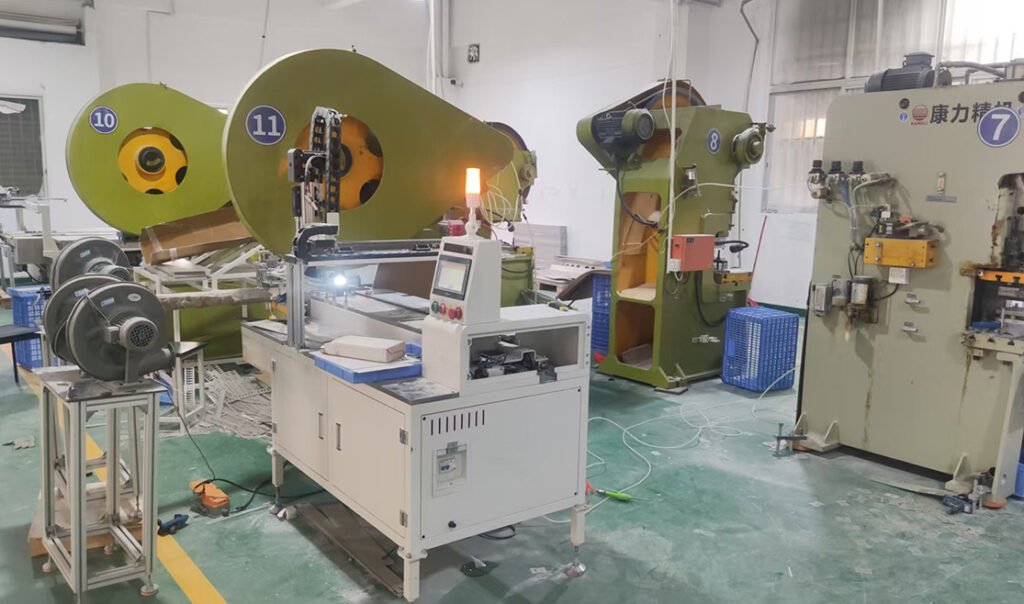
A practical example can be seen in the XZ-SL300 Automatic Mica Sheet Stamping and Feeding Machine developed by Xiezhan Machinery.
The machine combines feeding and stamping functions within a coordinated production process. Instead of relying heavily on operator positioning, material movement is controlled automatically, helping maintain consistency throughout production runs.
This becomes especially valuable for heater manufacturers processing large quantities of insulation components every day.
Several customer projects documented in our client cooperation cases demonstrate how automation has improved production stability while reducing manual handling requirements.
Why Material Quality and Feeding Accuracy Must Work Together
Another misconception is that premium mica sheets automatically guarantee premium products.
Material quality is essential, but even high-grade mica can produce inconsistent results if feeding accuracy is poor.
In fact, many experienced manufacturers evaluate raw material sourcing and production processes simultaneously.
For companies reviewing supplier options, this guide covering top mica sheet manufacturers provides useful background on sourcing considerations commonly discussed within the industry.
The most successful operations understand that quality is built through the combination of material selection, machine capability, and process control.
The Future Normal for Mica Stamping Operations
Looking ahead, the direction of the industry appears increasingly clear.
Manufacturers are moving toward production environments characterized by:
- Greater automation integration
- Higher process repeatability
- Reduced labor dependency
- More digital monitoring
- Improved production traceability
As these changes accelerate, feeding accuracy will become a standard expectation rather than a competitive advantage.
Factories that invest in process stability today are likely to achieve stronger operational performance tomorrow.
Final Thoughts
Feeding accuracy may not be the most visible specification on a machine datasheet, but it often determines whether a production line consistently delivers quality products.
The future of mica stamping is not simply about faster machines. It is about creating stable, repeatable, and scalable manufacturing processes that reduce variation at every stage.
For procurement teams evaluating a mica sheet punch press, automated feeding systems deserve the same level of attention as tooling, speed, and punching capacity.
If you are planning a new production line or upgrading an existing mica stamping operation, feel free to contact our engineering team to discuss the most suitable solution for your manufacturing requirements.